
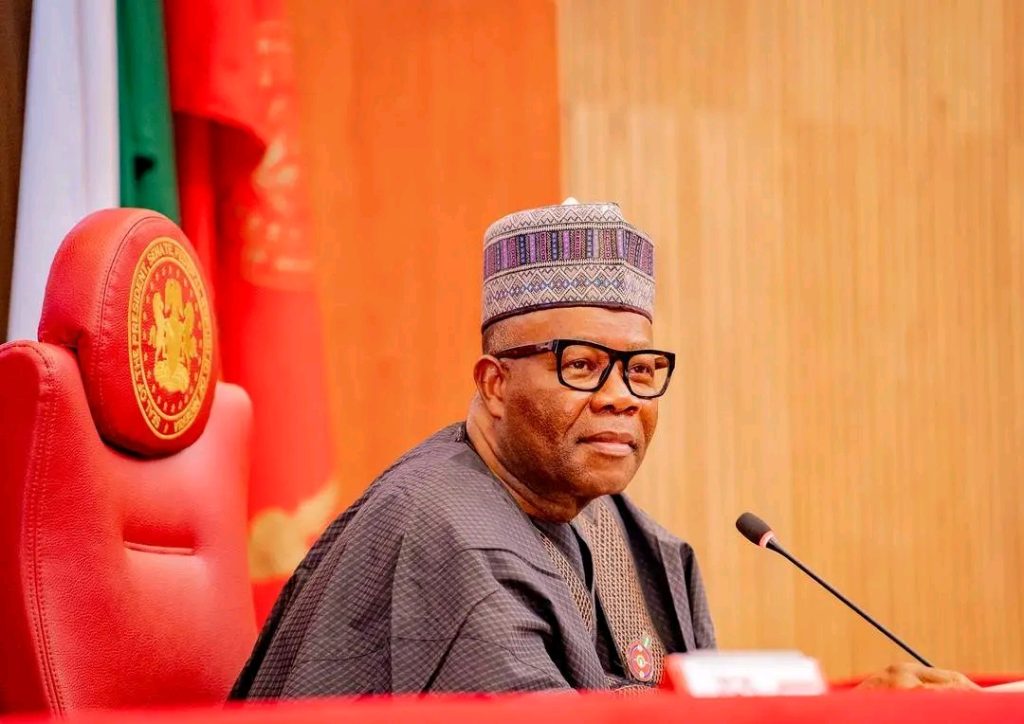
Senate President Godswill Akpabio has said the opposition in the National Assembly is close to disappearing, as more senators prepare to move into the ruling All Progressives Congress (APC).
Akpabio disclosed that only “four or five” senators are still outside the APC in the Senate, adding that even those remaining opposition lawmakers have indicated interest in defecting to the ruling party.
He said the development reflects the growing dominance of the APC at the federal level.
The Senate President made the remarks while addressing members of the APC National Caucus.
He used the occasion to highlight what he described as the steady collapse of opposition strength in the legislature and the widening influence of the ruling party across the country.
“When we came in, the opposition had almost 50 members, but today, when I counted, there were about five or four left in the opposition,” Akpabio said.
“Even those five members have whispered to me that I should carry them to the President and the leader of the party that they are prepared to join the APC.”
Akpabio praised the leadership of the APC, commending the National Working Committee led by Abdullahi Ganduje. He also acknowledged the role of Imo State Governor, Hope Uzodimma, in strengthening party unity and coordination.
According to him, the Senate has observed the APC’s expansion without major internal crises, noting that prominent political figures have joined the party peacefully, while opposition parties continue to lose members.
Despite celebrating the APC’s dominance, Akpabio said he does not support a National Assembly without opposition voices. He revealed that he deliberately allowed some senators who had defected to the APC at the state level to remain in the minority caucus at the Senate.
He explained that the move was taken to maintain balance and prevent the minority benches from becoming completely empty.
Akpabio specifically mentioned Enugu State Governor, Peter Mbah, for allowing Senator Osita Ngwu to continue in his role as Minority Chief Whip.
“I do not want to run a Senate without any opposition,” he said. “So because of that, I have intentionally -I’m reporting to the caucus – allowed the APC members who have declared in their states but are yet to declare in the Senate to continue in the minority caucus. Otherwise, that place would have been empty.”
On security, the Senate President expressed deep concern over the rising wave of violence across the country. He described the situation as “very serious, organised, and orchestrated insecurity,” adding that Nigerians were under deliberate attack.
“We are very sad that people have decided to torment Nigeria,” he said, while noting that the APC stands with states and communities mourning victims of attacks by “terrorists, bandits, and insurgents.”
Akpabio praised President Bola Tinubu for the rescue of more than 100 abducted children in recent operations. He called for sustained efforts to secure the release of those still held in captivity and paid tribute to security personnel who lost their lives in the line of duty.
He also spoke on legislative efforts to curb crime, revealing that the Senate had taken strong steps by reclassifying kidnapping as terrorism.
According to him, kidnappers will face the death penalty once the President assents to the bill.
“Kidnappers will now face the death sentence once the President assents to the new bill into law,” he said, urging state governors to enforce the law firmly.
Akpabio warned that weak enforcement would only encourage criminals to escape justice and return to society to commit more crimes.
He further highlighted the APC’s control of state governments, stating that the party now governs 28 out of Nigeria’s 36 states. He said the APC also enjoys a commanding majority in the National Assembly.
“In other words, APC governors are controlling 28 states out of 36 states in Nigeria, with an overwhelming majority in the National Assembly,” he said. “This is national consensus. This is national acceptance.”
The article was originally published on Politics Nigeria.